

Dave Rossum on the Filters Inside the 3rd Wave
If you’ve ever wondered why certain synthesizers just feel different when you sweep the filter, there’s a good chance the answer traces back to one person.
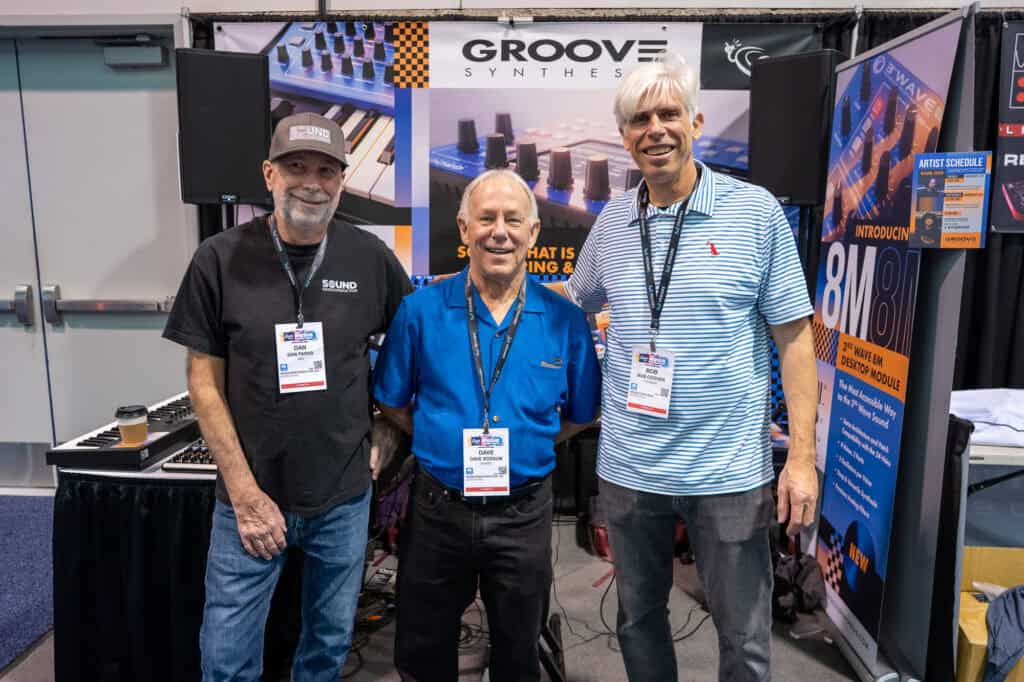
Dave Rossum designed the filter chips that defined the sound of the Prophet-5, the SP-1200, and dozens of other instruments that shaped modern music. So when Bob Coover invited him to the Groove Synthesis booth at NAMM 2026 to talk about the analog filters inside the 3rd Wave, things got nerdy fast. In the best possible way.
A Filter Designed on a Napkin
One of the highlights is Dave’s origin story for the SSM 2040 filter, the direct ancestor of the 2140 chip inside every 3rd Wave. It started at a restaurant with Tom Oberheim, who was struggling to get an operational transconductance amplifier (OTA) to work as a phase shifter. Dave grabbed a napkin from the table and sketched a circuit on the spot. Tom looked at it and asked, “Did you just invent that?” It was patentable. And it became the foundation for one of the most iconic filter topologies in the history of synthesis.
Greasy, Round, and Groovy
The conversation really hits its stride when Dave breaks down the sonic differences between the 2140 and 2144 filter chips. At low signal levels, Dave says he can’t even distinguish between them. But when you start driving the 2140 hard or cranking the resonance, its unique combination of symmetric and asymmetric distortion produces a cascade of even harmonics that gives it a warmer, thicker, greasier character. That’s the quality that made the Rev 1 and Rev 2 Prophets so revered.
The 2144, by contrast, stays cleaner and more symmetrical as you push it. Dave loves both, and as he puts it, they work differently with different kinds of music. But when it came to the 3rd Wave, Bob wanted that grease.
Why Bob Chose the 2140
Bob walks through his own journey with these chips during the 3rd Wave’s development. The 2144 was where things started, and it worked well. But once he got his hands on the 2140, the decision became clear. Beyond the sound, the 2140 offered practical advantages: a built-in tempco resistor for temperature stability and the ability to do resonance compensation, so you can choose whether the bass stays put or drops away as you bring up the resonance.
As Dave sums it up: the 2140 in the 3rd Wave is “kind of the best of all worlds, and the greasiest groove that you can get.”
We couldn’t agree more.
About Dave Rossum
Dave Rossum is a legendary analog and digital audio engineer whose chip designs have shaped the sound of synthesizers and samplers for over four decades. He co-founded E-mu Systems and Solid State Music (SSM), and his filter and VCA designs have been used in instruments from Sequential, Oberheim, Korg, and many others. Today he continues to design chips at Sound Semiconductor alongside Dan Parks.